
Improving Impact from UN Reports
+ Building Momentum Across Reports -> GBV

Reports are one of the key instruments in the toolbox of the UN Secretariat and entities. Secretary-General reports issued to the Security Council periodically analyze the political and humanitarian situations in the locations where there are peacekeeping and special political missions. Of 25 reports issued to the UNSC so far this year, they cover locations including Haiti, South Sudan, Afghanistan, the DRC, and Libya. Additionally, there are cross-cutting and thematic reports, such as on the threat posed by ISIL (Da’esh) and protection of civilians in armed conflict.1 Each of these reports carries the signature and weight of the Secretary-General.2
An adjacent set of reports that guide UNSC deliberations are those by Panels of Experts (PoEs) that assist the Council’s sanctions committees.3 Both SG and PoE reports inform the Council’s briefings and debates about the situations under consideration and then, certainly, any decisions including renewing the mandates of the Council’s operations and sanctions regimes.4 (The 96-page “Reporting and mandate cycles” captures each of the reporting and renewal deadlines.)
Snapshot of UN reports, with links to the UNSC:
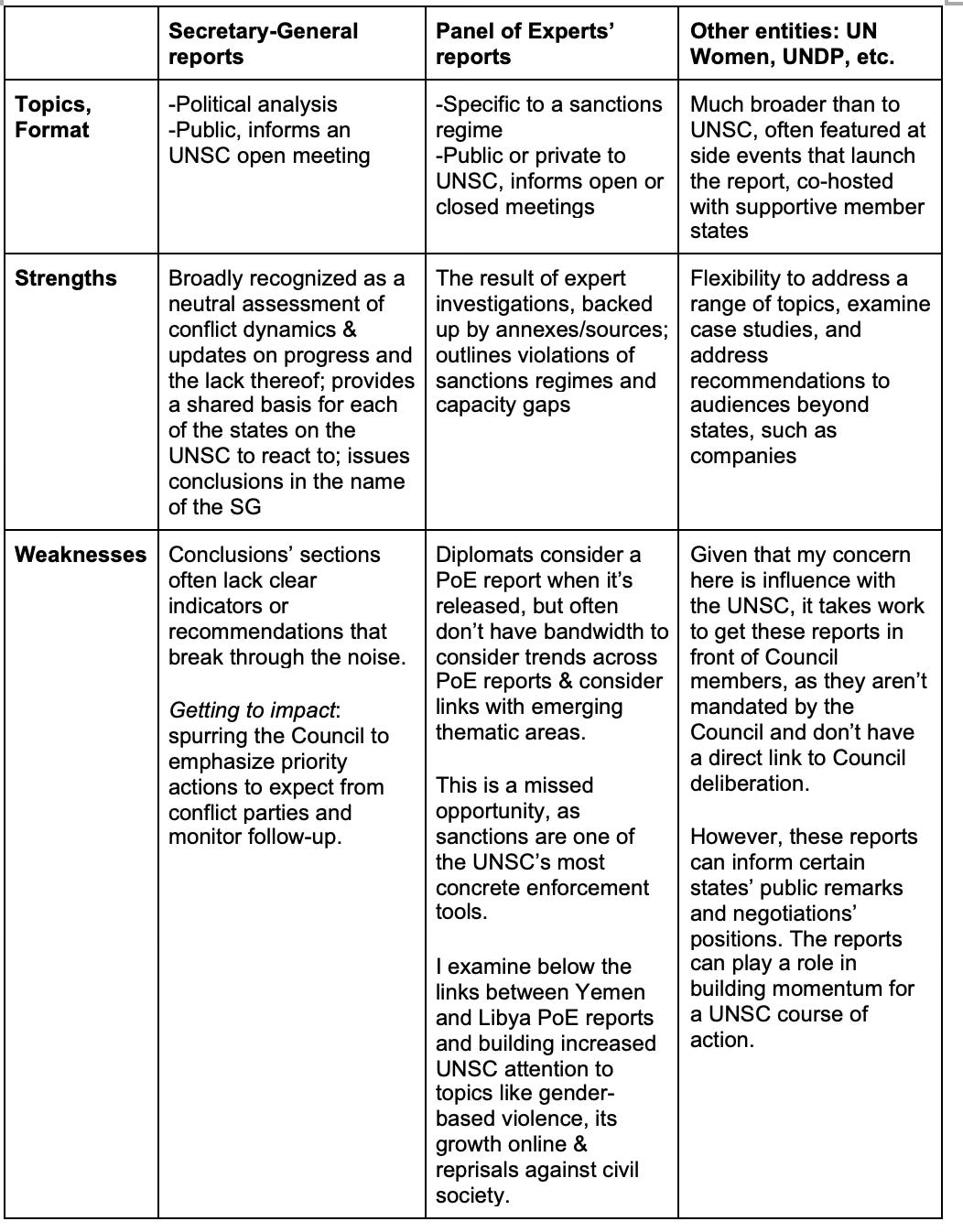
Three suggestions for improving impact of SG reports:
Prioritization: Beyond presenting authoritative analysis that is seen as comprehensive and balanced, SG reports should sharpen their recommendations for conflict parties and indicators for the Council to monitor in response. (This ties to risk-taking and top-cover from UN leaders in order for reports to set out plans for action.)
Trends: Highlight trends from previous reports and call out recurring issues: e.g. in the past X reports, Y has consistently been identified.
Issues of concern/potential blind spots: Include sections about issues of concern on the horizon, including due to insufficient information. Call for increased attention. Welcome related discussions with states, civil society, and others. If this is a step too far in reports themselves, consider posting on social media or UN entities’ websites that further attention to X and Y is welcome.
To be fair, grappling with how to increase impact from policy reports is certainly not limited to the UN. Last August, there was the glib headline that a UN report determined its reports are not widely read, calculated by low download numbers.5 Many thinktanks face similar worries. The article “Nonpartisan Institutions Need New Communications Strategies” is directed mainly at thinktanks and philanthropies.6 Admittedly, there are fundamental reasons for a SG report to be firmly bound by neutrality and a communications partnership with online influencers for a report issued to the UNSC would not be helpful. I still find broader inspiration from the article in thinking about how a SG report might experiment to bring attention to priorities and recommendations in a way that breaks through the noise.
Need for leadership:
This post was inspired by my course this spring and the class discussions and concern over the cases where the UN itself or the UNSC issues statements and, yet, generates negligible influence on conflict dynamics on-the-ground. How to increase impact from UN reports is tied to big-picture questions about the UN’s relevance and public perception. In class, we considered the video “How Decisions Are Really Made Inside the UN,” specifically Nudhara Yusuf’s presentation about different scenarios for UN reform and where the organization can maximize its comparative advantages, perhaps focusing on addressing catastrophic risk or local capacity-building.7
Relatedly, the CEPEI report (with roadmap here; shorter version with priorities here) on the new Secretary-General’s first 100 and 1000 days in office next year outlines top issues like building their team and presenting a clear vision in their early speeches. How they approach UN reform early on will be key. Will they articulate a counter-vision to beat back low internal morale and critiques that the UN primarily serves as a “talk shop”?
If the new SG and their leadership team sends the message that the UN system seeks to tackle key geopolitical challenges, including Haiti, Sudan, Afghanistan, that should issue top-cover for the Secretariat to explore updates in reports, such as the three suggestions I outlined above.
The role of reports should not be overlooked. They are a key instrument to focus the attention of Council members, generate a response, and identify priority next steps for at least monitoring, investigations, and potentially enforcement measures.
Building momentum, especially across Panel of Experts’ reports:
The attention span of diplomats and others at the UN is a significant commodity, bouncing between competing demands. Attention to any report can be concentrated or even limited to, unfortunately, the day or two of the SC, committee, or GA meeting about the topic. As a result, there is often a wealth of information in reports that are not unpacked or debated as they should.8 (Researchers should also play an important role in taking the time to unpack trends and priorities).
I give examples below of sections in PoE reports that touch on gender-based violence, the use of technology, and reprisals against civil society. These are important topics where the UN Secretariat and states should look across reports to provide cross-cutting attention and consider accountability and deterrent measures in response.
> Yemen Panel of Experts report, S/2025/650, para 145-149 on SGBV, includes: “Sexual violence is also used strategically to demoralize dissidents … Women activists face systematic targeting, including death threats and public shaming using real or doctored images.”
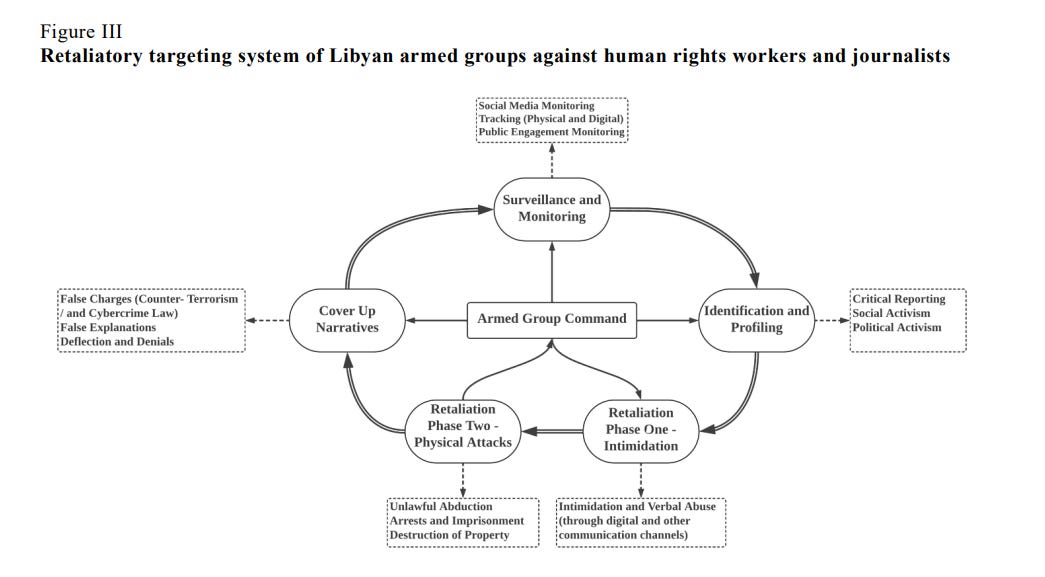
> Libya Panel of Experts report, S/2024/914, para 45 and annex 22, includes the below figure, which provides a notable framework applicable to other contexts:
> The 1267 Monitoring Team is distinct from PoEs’ investigative mandates in that the MT primarily relies on inputs provided by member states. The MT’s mandate in S/RES/2734 (2024) included significant recognition of SGBV as part of the listing criteria for the ISIL, AQ sanctions regime.9 Though it is disappointing that recent MT reports have not further examined SGBV developments, as they await input from member states.10
> To give positive examples where SG reports drew on PoE findings, the SG annual report about conflict-related sexual violence referenced the PoE reports for Sudan and Yemen. The CRSV report S/2025/389 (from last July) identifies that human rights defenders and others are subjected to reprisals in sections on Afghanistan, DRC, Gaza, Libya, Mali, Syria, Yemen, and Ethiopia. The SG’s recommendations include: “To create an enabling environment for women active in public life … and establish measures, including urgent response mechanisms to address reprisals, including for cooperation with the United Nations” (para 88 c).
> SG and PoE reports are by no means the only sources of information for the UNSC. Certainly, UN Women reports on and advocates to address tech-facilitated violence.11 And turning to an example where a member state could present lessons from its domestic action to issue a new national strategy on TFGBV: Pakistan issued a 2026-2030 strategy.
To return to the table of reports’ strengths and weaknesses, while it is positive that SG reports carefully maintain UN neutrality, there is the potential for their conclusions and recommendations to carry further weight and specificity. On the other hand, PoE reports reflect detailed investigations, yet, it takes intentional effort to examine cross-cutting themes.
Notwithstanding the Security Council’s failures in conflict resolution, it generally maintains a baseline function of convening states and ensuring channels of communication stay open. There are issues where the Council will not and should not be the body that is at the vanguard of new actions. However, even then, the Council can contribute to high-profile attention and it is one of the platforms that should be used to build a drumbeat of awareness and pressure for action, including drawing on its own reports. Supportive states should push to enhance the use of UN reports to deliver impact.
The annual sexual violence in conflict report received recent high-level attention for listing Israel and Russia as violators. The SVC and then the children in armed conflict reports are at the top of the list of SG reports that carry teeth, as they are mandated to explicitly list violators. Within thematic reports, there are also positive updates in the use of infographics and summaries, such as in last year’s annual SG report on WPS.
I am examining SG reports for the UNSC, but there are many more SG reports issued to the GA, a list of 67 this year here.
A Panel of Expert’s annual report should be publicly released, sometimes also an interim one, and often there are quarterly updates that are privately released only to the UNSC. Unfortunately, while the Secretariat publishes sanctions-related reports or press releases on specific Committee websites, they are not currently compiled in a single location that would increase awareness and accessibility. Many thanks to Tjasa Tanko for flagging this as an action that should be addressed.
Another important category of reports mandated by the UNSC are one-off independent reviews of peace operations. The 2021 IPI report by Daniel Forti directly examines these reviews, with an eye towards how their impact can be improved and particular attention on the follow-up stage.
Eugene Chen counters that low downloads miss the point of reports being tools of state oversight and signaling policy preferences, often as a compromise and an incremental step forward in negotiations.

The article tackles communications strategies. “The requirements to succeed on new media platforms are almost precisely the opposite of what successful experts, politicians, and advocates have trained themselves to do: maintain an institutional tone of formal detachment and stay ruthlessly on-message at all times.” “A one-off post or campaign rarely moves the needle.” “It means treating communication not as something to do once a report is complete, but as a core, ongoing component of the work itself.” Many thanks to Bojan Francuz for flagging.
Colin Smith, Coordinator of the 1267 and 1988 Monitoring Team, helpfully described reports as vehicles for discussion. 10:40 minute mark in this discussion.
Naureen Chowdhury Fink and Cyndee Trinh wrote about this. They in turn reference the key IPI report on CRSV and sanctions by Lauren McGowan and Jenna Russo, which precisely demonstrates cross-cutting analysis across sanctions regimes.
Para 109, S/2025/482
UN Women, “Digital abuse, trolling, stalking, and other forms of technology-facilitated violence against women and girls,” Nov 2025 FAQs. And regarding counter-terrorism, CTED has issued reports on accountability for SGBV, with a section on technology-facilitated violence, p.17-19. “Civil Society Perspectives: Advancing Accountability for Sexual and Gender-Based Violence linked to Terrorism”
This is really smart. They all run the gamut so the specific suggestions are useful!
Well written and interesting article.